
Insurance prices do not move in one direction forever.
At different points in the insurance cycle, businesses may experience rising premiums, stricter underwriting and fewer insurer options. At other times, conditions become more competitive, creating what is commonly known as a soft insurance market.
Understanding how these cycles work can help your business make more informed decisions at renewal, considering coverage and policy terms alongside premiums.
What is a soft insurance market?
A soft insurance market occurs when insurers have a greater willingness and ability, to accept risk and compete for business. This can create more choice and greater flexibility for insurance buyers.
This may result in:
- increased competition between insurers
- more insurers willing to quote on certain risks
- slower premium growth and in some cases, premium reductions for some businesses and certain industries
- greater flexibility around policy terms and conditions
- potential access to broader cover or additional policy extensions.
It should be noted that the availability of these outcomes varies by insurer, industry and individual risk.
A soft market is the opposite of a hard insurance market, where insurer appetite is more limited, underwriting is stricter and premiums typically increase.
Not every business experiences the same market conditions at the same time. Industry, location, claims history and individual risk characteristics can all influence how insurers assess a business.
Why do insurance markets move in cycles?
Insurance markets are influenced by factors including insurer profitability, claims costs, reinsurance conditions, investment performance and global events.
When insurers achieve stronger results and have more capacity available, competition often increases. When major loss events, economic pressures or rising claims costs affect profitability, insurers may tighten their underwriting approach.
Different insurance classes can move through the cycle at different times, and there is no fixed timetable for conditions to change.
What does a soft insurance market mean for your business?
A soft market can create opportunities for businesses to revisit insurance decisions made when cover was more expensive or harder to obtain.
Any review should also account for how the business has changed, including growth, new services or locations, higher asset values and greater reliance on technology. These changes may affect insurance requirements regardless of broader market conditions.
Lower premiums are only part of the picture
A lower premium can be attractive, but it should not be the sole basis for comparing insurance options.
Two policies may appear similar while offering significantly different:
- limits of cover
- excess levels
- policy exclusions
- sub-limits
- definitions
- claims conditions
Understanding those differences can be just as important as understanding the price.
Revisit earlier compromises
Businesses sometimes make compromises when insurance markets are challenging. These might include:
- accepting higher excesses
- reducing policy limits
- retaining more risk within the business
- removing optional extensions
If market conditions become more competitive, there may be an opportunity to revisit those decisions. Depending on insurer appetite and your risk profile, alternative arrangements may now better suit your business.
Five questions to ask when reviewing your insurance program
A renewal review is an opportunity to assess whether your insurance program continues to align with your operations, organisational structure and risk profile. The following are general discussion points you may wish to raise with your broker. The approach will depend on your business circumstances and the terms offered by insurers.
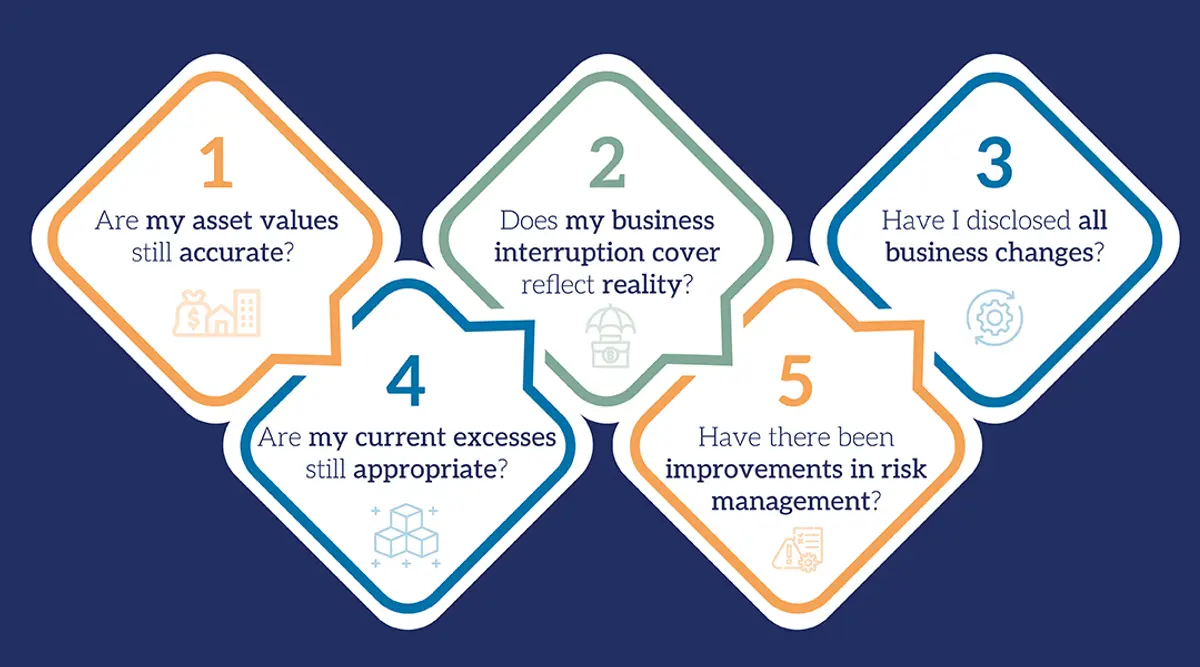
Five questions to ask when reviewing your insurance program
1. Are my asset values still accurate?
Construction costs, equipment prices and replacement values can change over time. Outdated valuations may increase the risk of underinsurance.
2. Does my business interruption cover reflect reality?
Business interruption policies may include an indemnity period, which is the period for which an insured interruption may be covered, subject to the policy terms. Ask your broker whether the financial information and indemnity period used for your cover remain appropriate for your business.
3. Have I disclosed all business changes?
New premises, acquisitions, services, contracts and operational changes may all be relevant to insurers. Discuss these changes with your broker rather than waiting until renewal.
4. Are my current excesses still appropriate?
Consider how much your business could comfortably contribute towards a claim and whether the available excess options still suit your financial position.
5. Have there been improvements in risk management?
Cyber security improvements, staff training, documented safety procedures and incident reporting, business continuity planning, maintenance programs and internal claims management processes, may help demonstrate how your business manages its risks.
Sharing relevant risk-management information can help insurers understand how your business identifies and manages its risks. Pricing, coverage and insurer appetite will continue to depend on the individual risk and broader market conditions.
How your insurance broker can help
Market conditions can create opportunities, but every business presents a different risk profile.
A broker can help you:
- understand how insurers are viewing your industry
- compare policy options beyond premium alone
- identify gaps or overlaps in cover
- review changing business exposures
- prepare information that supports renewal discussions with insurers
Your broker can help you assess whether the available options offer appropriate cover, terms and value for your business.
Make your next insurance renewal count
Understanding your options can help you make more informed decisions in any market conditions.
Speak with a PSC insurance broker about your business insurance requirements.